
Last updated: October 13, 2026
Hyaluronic acid lip augmentation uses an injectable, absorbable gel to add fullness and refine lip contours. At Esthetica Orange County in Newport Beach, California, our Lip Augmentation options include hyaluronic acid filler for adults concerned about thin, uneven, or aging lips; the right amount and placement depend on each person’s anatomy and goals.
What Is Hyaluronic Acid Lip Augmentation, and How Does It Work?
Hyaluronic acid lip augmentation places a formulated gel in the lips to increase fullness and adjust shape or definition. Hyaluronic acid also occurs naturally in the body and helps retain moisture, but cosmetic filler is an injectable product rather than the body’s own hyaluronic acid. The gel is gradually absorbed, so the enhancement is temporary.
What can hyaluronic acid filler change about lip volume, shape, and definition?
A hyaluronic acid lip filler can add volume to thin lips, improve the balance between uneven lips, or make the lip border more distinct. Carefully chosen placement may also soften some fine lines around the mouth. An article about lip augmentation on the American Society of Plastic Surgeons’ website explains that injections in selected areas can balance lip shape as well as increase fullness. Natural lip augmentation means planning a change that suits the rest of the face, not promising that filler will produce the same look for everyone.
What Does the Clinical Evidence Say About HA Lip Filler Results?
Clinical evidence from reviews, a randomized comparison, and a small upper-lip study supports hyaluronic acid filler as a way to increase lip fullness. The studies differ in design, products, outcome measures, and follow-up, so none guarantees a particular shape, duration, or complication-free treatment for an individual patient.
What did the 2021 meta-analysis find about effectiveness and safety?
The 2021 Frontiers in Surgery meta-analysis reviewed randomized trials alongside observational studies and case reports. Researchers assessed increased lip fullness and treatment-related adverse events. The responder estimates below refer to participants whose lip fullness increased by at least one grade; they are study findings, not a prediction for every patient.
The 2021 Frontiers in Surgery meta-analysis reported these responder estimates:
| Time after injection | Participants meeting the study’s responder definition |
|---|---|
| 2 months | 91% |
| 6 months | 74% |
| 12 months | 46% |
The same meta-analysis found that most reported adverse effects were mild or moderate, although a small number were serious. The researchers also called for stronger randomized trials, an important limit when interpreting the overall evidence.
What did the 2019 systematic review find?
In a 2019 systematic review of 22 studies involving 3,965 participants, reported lip-fullness response rates ranged from 71% to 93.2%. The studies used substantially different assessment methods, so that range is not directly interchangeable with the 2021 meta-analysis’s estimates for a one-grade improvement at specified follow-up times.
What did a randomized HA filler trial find?
In a 2021 randomized, evaluator-blinded, 48-week trial with an optional week-4 touch-up, one HA filler was noninferior to an HA comparator for lip fullness at week 8 after the last injection. Lip-fullness improvement with the studied product persisted through week 48. That product- and study-specific finding does not mean every patient will see a year of results; at Esthetica Orange County, lip fillers typically last 3–6 months.
What does the 2017 upper-lip study add?
A 2017 Journal of Cutaneous and Aesthetic Surgery before-and-after study followed 10 healthy adult women treated with a particular hyaluronic acid gel in the upper lip. A response meant an improvement of at least one grade on the Medicis Lip Fullness Scale: 80% responded at two weeks, 70% at 12 weeks, and 80% at 24 weeks. Reported adverse effects were mostly mild and temporary. Because the study was small and had no comparison group, its response rates cannot predict an individual patient’s result.
Who Might Be a Good Candidate for HA Lip Fillers?
Adults seeking modest lip fullness, improved symmetry, or clearer contours may be candidates for hyaluronic acid filler. Suitability depends on lip anatomy, medical history, and realistic treatment goals, not appearance alone.
Can filler help with thin lips, uneven lips, or lip lines?
Yes. If the main concern is uneven fullness, targeted injections can add volume where it is lacking rather than enlarging both lips equally. Filler can also define the lip border; treating fine lines above the upper lip depends on whether the selected product is approved for that area.
When should you discuss another approach at your consultation?
A lip lift changes lip position through surgery rather than adding injectable volume, so it may suit someone whose goal is to change lip position rather than fullness.
What Happens During a Hyaluronic Acid Lip Filler Appointment?
At Esthetica Orange County, injectable lip augmentation takes under an hour, although the amount and placement vary with the patient’s lip shape and desired change.
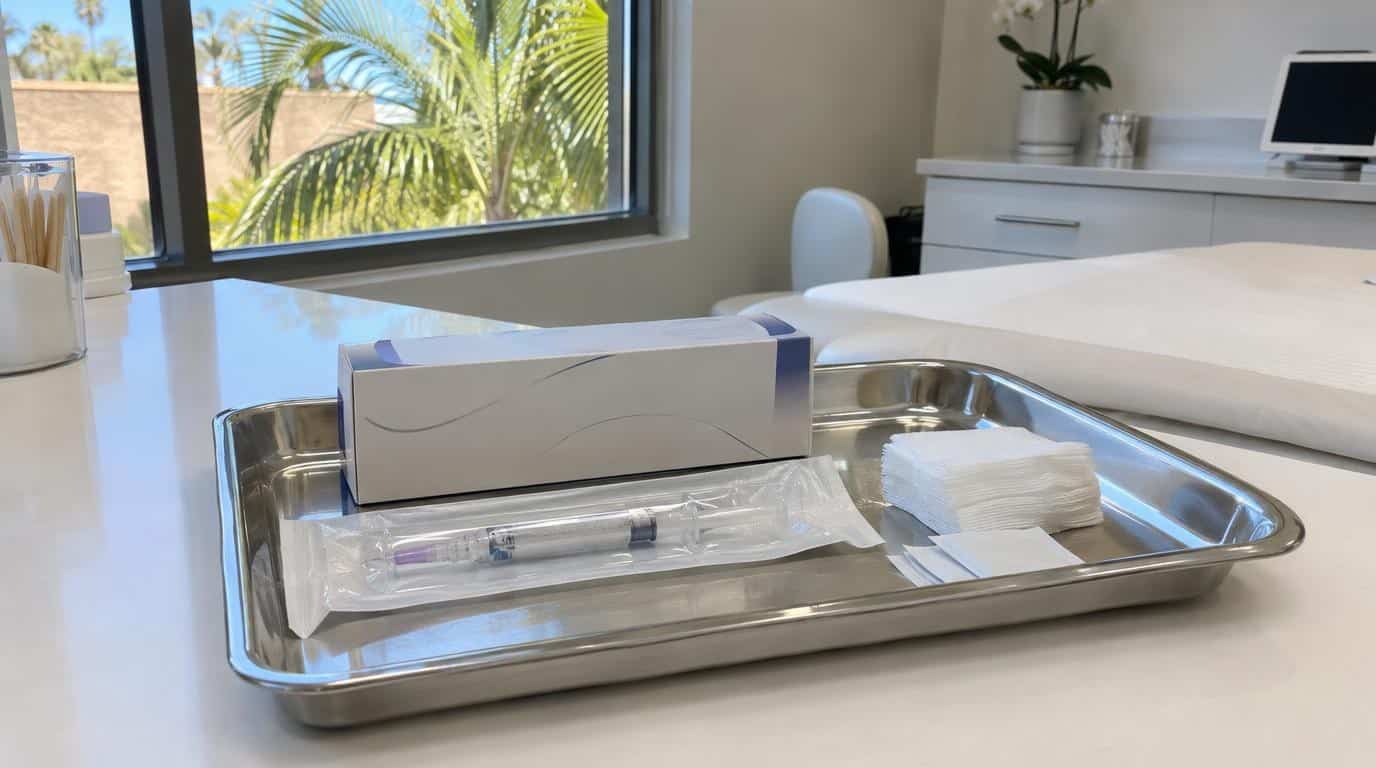
How are the lips prepared and the filler placed?
- Plan the treatment. The consultation identifies areas where added volume or definition may help and sets a realistic goal.
- Prepare the lips. Our team disinfects the treatment area and applies a topical anesthetic for comfort.
- Place the filler. A fine needle delivers a series of injections in the selected areas around the lips and mouth.
- Check the distribution. The clinician gently massages the treated areas to distribute the gel.
How Long Does It Take for Hyaluronic Acid to Plump Your Lips?
Added lip fullness is usually visible immediately after hyaluronic acid filler injections, but early swelling can make the lips look different from the settled result. At Esthetica Orange County, most patients see the result settle over 7-10 days.
When can you judge the final result?
Use the appearance after swelling has subsided to assess fullness, symmetry, and border definition. If an area still concerns you after it settles, bring it to the treating team’s attention rather than assuming more filler is needed.
How long do HA lip filler results usually last?
At Esthetica Orange County, lip fillers typically last 3-6 months as the absorbable gel gradually breaks down. Duration can differ between patients and products. Anyone who wants to maintain fullness can discuss whether a touch-up fits their goals once the result begins to fade. For a smaller-volume option, learn how long half a syringe lip filler may last and what affects its duration.
What Are the Worst Days After Lip Fillers?
There is no universal “worst day” after lip filler. The first day or two may bring the most visible swelling; Cleveland Clinic’s lip filler overview says swelling usually subsides within 24 to 48 hours, although it can take up to a week. At Esthetica Orange County, redness, soreness, or tenderness usually subsides within five days.
What swelling or tenderness is typical during the first few days?
Bruising can appear at injection sites, and an ice pack can help ease swelling and discomfort. You can usually return to work right away, but visible swelling may affect plans for photographs or an important event during the first few days.
When should symptoms prompt a call to the treating clinician?
Contact the treating clinician promptly if swelling worsens instead of improving. Severe or escalating pain, pale or dusky lip skin, or any vision change after filler needs immediate medical attention; do not wait for a routine follow-up. These warning signs can indicate a blood-vessel blockage, which requires urgent assessment.
What Are the Risks of HA Lip Fillers, and Who Should Avoid Them?
Hyaluronic acid lip fillers commonly cause temporary local reactions, but uncommon serious complications can occur. A blood-vessel blockage is particularly important because it needs immediate care. People with an active cold sore or infection near the injection area should not proceed until a clinician has assessed them; known allergies or prior reactions also require assessment before treatment.
Which side effects are common, and which complications need urgent care?
The 2021 Frontiers in Surgery meta-analysis estimated the following treatment-related adverse-event rates among the participants assessed for safety. These rates describe the studies reviewed, not the likelihood for a particular patient or filler product.
| Adverse event in the 2021 meta-analysis | Estimated rate |
|---|---|
| Tenderness | 88.8% |
| Injection-site swelling | 74.3% |
| Bruising | 39.5% |
Redness and soreness can also occur. Allergic reactions are uncommon, not impossible. Unintentional injection into a blood vessel is uncommon but can cause skin damage, vision loss, or stroke. The ability to dissolve HA filler does not prevent these serious complications.
Why do cold sores or certain health conditions matter before injections?
Injection can aggravate an active cold sore. The 2021 Frontiers in Surgery meta-analysis reported foreign-body granulomas in 0.6%, herpes labialis (cold sores) in 0.6%, and angioedema in 0.3% of participants assessed for adverse events; these study-specific rates do not predict the risk for a particular patient or filler product. Tell the treating clinician about a history of cold sores, blood disorders or other relevant conditions, medications, and any reaction to a previous filler. A history of anaphylaxis or multiple severe allergies, or a known allergy to an ingredient such as lidocaine in a lidocaine-containing filler, can rule out treatment with that product. Smoking should also be discussed during screening. Do not have injections through an active infection or assume a past reaction is harmless; discuss your own risks and eligibility with your licensed clinician before treatment. Injector training, familiarity with lip anatomy, and a clear plan for handling complications are essential.
How Do HA Lip Fillers Compare With Fat Transfer for Lip Augmentation?
Hyaluronic acid filler is an injectable, temporary option with little downtime, while fat transfer is a more involved procedure using a patient’s own harvested fat. Esthetica Orange County offers both. Filler may suit someone seeking an adjustable volume change; fat transfer may be considered when filler alone cannot achieve the desired result.

When might fat transfer be considered instead of filler?
Fat transfer involves anesthesia, liposuction to harvest fat—often from the abdomen, flanks, or thighs—processing the fat, and reinjecting it into the lips. Some transferred fat may be reabsorbed, so lasting lip volume can vary. Our comparison of surgical and nonsurgical facial contouring offers broader context for weighing approaches with different recovery demands.
How do the procedure, recovery, and duration differ?
At Esthetica Orange County, the practical differences between these options include:
| Consideration | HA lip filler at Esthetica Orange County | Lip fat transfer at Esthetica Orange County |
|---|---|---|
| Procedure | Injections in under an hour | Fat removal, processing, and lip injection; up to two hours |
| Recovery | Little downtime; redness, soreness, or tenderness usually settles within five days, while swelling, bruising, or lumps can last longer | Lip soreness or swelling for up to a week; light activities and work can generally resume after about one week; donor-site healing continues over subsequent weeks, with full recovery expected within six weeks |
| Results | Typically last 3-6 months | May last for years, but permanence is not guaranteed |
In U.S. Food and Drug Administration labeling for Juvéderm Ultra with Lidocaine, some lip-augmentation study participants reported swelling or lumps lasting 15–30 days. That product-specific finding does not predict your recovery time.
Fat transfer can also cause bruising or swelling at the fat-harvest site, which may take weeks to resolve.
How Can You Evaluate Upper-Lip Filler Before-and-After Photos?
Upper-lip filler photos are most useful when the before and after views have similar angles, lighting, expression, and timing. Consented before-and-after examples can illustrate changes in contour, but they cannot predict how your own anatomy will respond.
Check when each after photo was taken: a treatment-day image may show swelling, while a later image taken after swelling subsides is more useful for judging the result. Compare the upper lip with the lower lip and surrounding face, not just its apparent size. Photos also cannot reveal how the lips feel, how long the result lasts, or whether that patient had side effects.
For an example, view the American Society of Plastic Surgeons’ upper-lip filler before-and-after case. The images show increased upper-lip volume and projection and a more prominent Cupid’s bow. They show another clinician’s patient, not Esthetica Orange County results or a prediction for your treatment.
Frequently Asked Questions
Are lip fillers still popular in 2026?
Yes. Hyaluronic acid filler remains a popular minimally invasive option for lip enhancement. A 2026 article on the American Society of Plastic Surgeons’ website describes hyaluronic acid as by far the most popular type of lip filler. Popularity alone does not make it the right choice for everyone; your lip anatomy and goals should guide treatment.
When can I eat or drink after lip fillers?
Wait until the numbing medicine wears off before eating so you do not accidentally bite your lips. Cleveland Clinic also recommends avoiding messy foods that require wiping your lips, drinking straws, and smoking for at least 24 hours. Follow any additional instructions from your treating clinician.
Can I work out after getting lip fillers?
Light activity is generally fine, but hold off on vigorous workouts for several days after lip filler. Intense exercise can increase blood flow and worsen swelling or bruising, according to Cleveland Clinic aftercare guidance.
Are lumps normal after lip filler?
A slightly bumpy texture immediately after injections can be normal, and you may feel filler when pressing your lips together. Large, visible, hard, painful, or persistent lumps should be assessed by your provider, according to Cleveland Clinic. Do not assume every lump is temporary or try to correct it yourself.
Can hyaluronic acid lip filler be dissolved if I do not like it?
Yes. A qualified healthcare provider can inject hyaluronidase to break down hyaluronic acid lip filler. Cleveland Clinic notes that dissolving can cause temporary swelling or bruising and that full results may take two weeks. Tell your provider about allergies, including any history of a bee-sting reaction, before considering treatment.
What is the difference between lip filler and a lip flip?
Lip filler adds injectable volume and can refine lip shape. A lip flip uses a small amount of neuromodulator to relax the upper-lip muscle so the lip is less likely to turn inward when you smile. The better option depends on the change you want.
Are needle-free hyaluron pens a safe alternative to lip filler injections?
Do not assume a needle-free hyaluron pen is a safer substitute for clinician-administered lip filler. It uses pressure to push hyaluronic acid through the lip rather than a needle, and Cleveland Clinic notes that these devices are not approved by the U.S. Food and Drug Administration. Discuss lip enhancement with a qualified healthcare provider.
What Should You Ask Before Scheduling HA Lip Augmentation in Newport Beach?
Before scheduling hyaluronic acid lip augmentation, ask who will perform the injections, what change is realistic for your lips, and how the team manages recovery and complications. Discuss whether filler or fat transfer better fits your goals.
- Injector: What training and experience does the person placing my lip filler have?
- Goal: What degree of fullness, symmetry, or border definition is realistic for my anatomy?
- Approach: Can filler meet that goal, or should I consider fat transfer?
- Recovery: What precautions should I follow, and when should I assess the settled result?
- Safety: How should I reach the treating team with a concern, and how are complications handled?
If you are considering lip enhancement, contact Esthetica Orange County to arrange a personal consultation with Dr. Wael Kouli and the team in Newport Beach, California. We can review your goals and medical history, explain the options we offer, and help you decide whether treatment is appropriate without promising a particular result.
This information is general and is not medical advice. Talk to a licensed clinician about your own situation before making a treatment decision.