Last updated: November 14, 2026
A mini face lift is generally a shorter-incision facelift for early sagging in selected facial areas, often the jowls and jawline. The name does not identify one standard operation, so the useful question is what a surgeon would lift, where the incisions would be, and whether a broader facelift would better address your goals.
What Is a Mini Face Lift?
A mini face lift is generally a limited facelift aimed at early changes such as jowls and reduced jawline definition. A short scar facelift or partial facelift may describe a similar approach, but those names do not specify exactly which tissues or facial areas a surgeon will treat.
A May 2024 article by Ariel Frankeny on the American Society of Plastic Surgeons website describes mini facelifts as less invasive variations of traditional facelifts with quicker recovery. The surgeons interviewed explain that techniques differ: a limited lift may focus on a particular area rather than the entire face.
At Esthetica Orange County, our facelift surgery repositions underlying facial tissues, redrapes the skin and removes excess skin as appropriate.
Does the term “mini facelift” describe a standard operation?
No. Surgeons use “mini facelift” for more than one shorter-scar operation. Some techniques tighten deeper supporting tissue, while others involve more limited tissue work; the name alone does not specify whether the cheeks or neck will be lifted.
What Happens During a Mini Face Lift?
A mini face lift commonly uses shorter incisions near the ears to reach and lift selected facial tissues. Depending on the plan, the surgeon may tighten deeper tissue, redrape skin, or remove some excess skin. The American Board of Cosmetic Surgery’s facelift guide notes that a mini facelift may use local anesthesia with sedation or general anesthesia, depending on the case.

The American Society of Plastic Surgeons’ facelift procedure guide describes shorter incisions at the temples and around the ears as an alternative to a traditional incision. The guide notes that mini-lifts are generally reserved for patients with less loose skin and produce less rejuvenation than full facelifts.
Our documented full facelift follows a broader plan: incisions extend from the temples around the ears toward the nape of the neck. Dr. Wael Kouli lifts the skin, repositions underlying tissues, redrapes the skin over the new contours, and removes excess skin as appropriate. That description should not be assumed to apply to an unspecified mini technique.
Which areas and tissue layers should I ask the surgeon about?
A targeted mini lift often focuses on the jowls and jawline, although some techniques also address the cheeks or part of the neck. Techniques differ in whether they reposition deeper supporting tissue and how much excess skin they can remove. Shorter incisions generally offer less access for extensive lifting than those used in a full facelift.
What Is the Difference Between a Mini Face Lift and a Full Face Lift?
A mini face lift generally treats fewer areas through shorter incisions, while a full facelift can address more extensive changes. Neither name guarantees a particular cheek, jawline, or neck result. These are the usual differences:
| Consideration | Mini face lift | Full facelift |
|---|---|---|
| Typical concern | Early sagging, such as mild jowling | More extensive facial or neck sagging |
| Incisions | Usually shorter, near the ears and sometimes the temples | Longer, typically extending around the ears and into the hairline |
| Extent of change | Usually more limited | Can address more areas and remove more excess skin |
| Recovery | Usually shorter | Generally longer |
Our full facelift may also remove unwanted fat to refine facial contours. These questions can help you compare the details of proposed approaches:
- Incisions: Where will they begin and end?
- Regions: Will the plan treat the cheeks, jawline, neck, or only selected areas?
- Tissue work: Will deeper tissues be repositioned, and will excess skin be removed?
- Expected change: Which visible concerns are likely to improve, and which may remain?
- Recovery: What aftercare and activity restrictions apply to the proposed operation?
For more context on the distinction, see this educational overview of lower face lift treatment areas and recovery.
Will a mini face lift address loose neck skin or sagging cheeks?
Possibly, but not automatically. Some limited lifts include selected neck or cheek work; others concentrate on the jowls and jawline. Substantial loose neck skin or more widespread cheek descent may call for a broader approach. A lift focused on the jowls should not be expected to remove substantial excess neck skin or restore lost cheek volume.
Who Might Be a Candidate for a Mini Face Lift?
A mini face lift may suit an adult with relatively limited lower-face laxity who wants a modest, targeted change. Candidacy depends on facial anatomy, treatment goals, general health, and the ability to follow aftercare instructions. A person with more extensive sagging may need a broader operation to address the areas of concern.
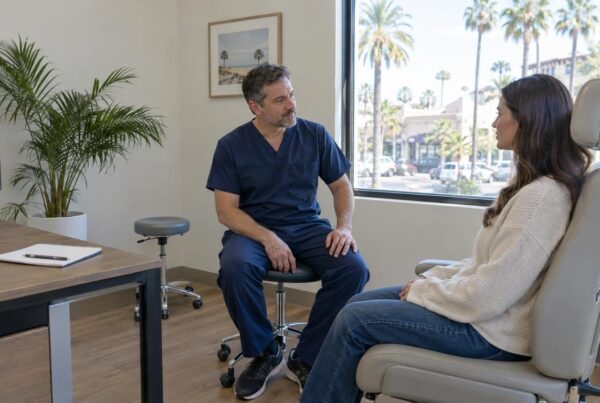
At Esthetica Orange County, Dr. Kouli reviews medical information and examines facial skin and structure during a one-on-one facelift consultation. The amount and location of loose tissue help determine whether a limited or more extensive lift could address a patient’s concerns.
What Is the Best Age to Get a Mini Facelift?
There is no single best age. The American Society of Plastic Surgeons’ discussion of facelifts in younger patients says mini facelifts are typically recommended for people in their 40s or 50s, but the degree of sagging, overall health and treatment goals matter more than age alone. Younger people, including those in their 30s, should discuss whether surgery is warranted; another ASPS discussion of mini facelifts cautions against too much surgery too soon. The Cleveland Clinic’s facelift guide distinguishes early looseness from the greater excess skin that often leads surgeons to recommend a traditional facelift.
How Long Does Recovery Take After a Mini Face Lift?
Recovery after a mini face lift is often quicker than after a traditional facelift. Cleveland Clinic says less invasive procedures such as mini facelifts usually require five to seven days off work; a physically demanding job may require more time. Swelling, bruising, activity limits and follow-up instructions depend on the operation and how you heal, not on the word “mini.”
For comparison, our facelift patients can expect two weeks of recovery, with discomfort, swelling, bruising and stiffness usually most pronounced during the first few days. Most light activities can resume in 1-2 weeks, and more strenuous workouts within six weeks. These are our facelift guidelines, not a promised schedule for every mini technique.
What Results Can a Mini Face Lift Realistically Provide?
A mini face lift may improve selected early changes in the lower face, particularly mild jowling or loss of jawline definition. A limited lift should not be assumed to correct extensive sagging, prominent neck bands, or lost facial volume. Shorter scars can come with a narrower change, and no procedure name guarantees an appearance or duration.
Our full facelift aims for smoother skin and better-defined facial contours after swelling subsides. Patients whose main concern is cheek descent can also read about deeper facelift approaches to midface rejuvenation. A lift repositions tissue; it does not necessarily replace lost volume.
Evidence should also be interpreted carefully. A 2026 systematic review in Aesthetic Surgery Journal Open Forum examined facelift randomized trials and found that reporting was variable. The review assessed research quality across facelift studies, not a guaranteed result for any individual mini-facelift technique.
The review’s key figures show why precise comparisons between techniques remain difficult:
| Source | Finding |
|---|---|
| 2026 systematic review | Ten randomized trials included 457 participants. |
| 2026 systematic review | Mean reporting-checklist adherence was 56%. |
What Are the Risks of a Mini Face Lift, and Who Should Avoid It?
A mini face lift is surgery and carries risks despite its limited scope. Swelling and bruising are expected during healing; possible complications include bleeding, infection, unfavorable scarring, and anesthesia-related problems. Surgery may need to be deferred if a health condition makes surgery or healing unsafe, or if you cannot stop nicotine for the instructed period.
The American Society of Plastic Surgeons’ facelift overview notes that surgery cannot stop the aging process. At Esthetica Orange County, our facelift guidance calls for stopping smoking and other nicotine products for the months before and after surgery. We also review medicines and supplements that could affect the operation. Do not stop a prescribed medicine without instructions from the clinician managing it.
After surgery, contact the surgical team promptly about worsening redness, fever, increasing pain, or unexpected bleeding or swelling. Seek urgent medical care for trouble breathing, chest pain, or other severe symptoms. Discuss your own risks and eligibility with your clinician; only an individual assessment can determine whether surgery is appropriate.
What Can I Do Instead of a Mini Facelift?
Alternatives to a mini facelift depend on the concern being treated. A full facelift may better address broader cheek, jawline, and neck changes. Brow or eyelid surgery targets those respective areas, but neither substitutes for lifting jowls.
At Esthetica Orange County, we offer cheek filler or facial fat transfer for lost facial volume, Botox for certain expression lines, laser skin resurfacing for skin texture and some wrinkles, and Ultherapy for modest tightening of mild skin laxity. These treatments cannot remove substantial excess skin or reposition deeper tissues as a surgical facelift can, so they do not replace a lift for pronounced jowls. You can explore our comparison of surgical and nonsurgical facial rejuvenation results or read about FaceTite for neck and jawline concerns.
Frequently Asked Questions
Can a mini facelift be done with local anesthesia?
Yes, some mini facelifts can be performed with local anesthesia and sedation, while others require general anesthesia. The choice depends on the operation and your health. Do not assume a shorter incision means you will stay awake.
Will I need follow-up appointments after a mini facelift?
Yes. Follow-up visits allow your surgeon to check healing, examine your incisions and advise you about resuming activities. The schedule depends on the operation; our full facelift patients return for regularly scheduled follow-up appointments with Dr. Kouli.
Where are mini facelift scars located?
Mini facelift incisions are typically placed near the ears, sometimes extending into the hairline above them. Shorter incisions still leave scars, and their precise location depends on the surgical plan. Scar visibility varies with incision placement and individual healing.
How long do mini facelift results last?
Mini facelift results are not permanent, but improvement can last several years. A surgeon interviewed in the American Society of Plastic Surgeons’ mini-facelift article describes results lasting several years for his patients; that is his experience, not a guaranteed duration for others. American Academy of Ophthalmology EyeWiki notes that sagging can recur as early as two to three years after some mini facelifts and describes longer-lasting improvement after full facelifts. A more extensive lift may last longer, but neither operation has a predictable duration for every patient.
Will a mini facelift get rid of fine lines and sun damage?
No, a mini facelift primarily lifts loose tissue; it does not directly treat every fine line or change sun-damaged skin. An article on the American Academy of Facial Plastic and Reconstructive Surgery website explains that wrinkles are better addressed with treatments such as lasers or peels.
Can I have eyelid surgery or a brow lift with a mini facelift?
Potentially, yes. Eyelid surgery and brow lifts can be paired with facelift surgery when the treatment goals and surgical plan support it, but neither replaces a lift for jowls. At Esthetica Orange County, we offer eyelid surgery and endoscopic brow lifts; whether procedures can be combined depends on a patient’s health and surgical plan.
Do I need someone with me after a mini facelift?
Yes, arrange a ride home and help during early recovery. Cleveland Clinic advises having someone stay with you for at least the first 48 hours after facelift surgery. Our facelift patients also arrange pickup after surgery.
How Can I Decide Whether a Mini Face Lift Is Right for Me?
Decide by comparing a specific surgical plan with your concerns, not by choosing the most appealing procedure name. Clarify the areas and tissue layers to be treated, the likely limits of the result, and the recovery instructions. A broader facelift may better address sagging that extends beyond the areas a limited lift can treat.

For patients coming from Tustin, our Newport Beach office offers a one-on-one facelift consultation with Dr. Wael Kouli.
What should I ask during a facelift consultation?
- Do you offer a mini face lift, and what exactly would that operation involve in my case?
- Which parts of my cheeks, jawline, and neck would the plan address?
- Would you reposition deeper tissue, remove excess skin, or both?
- What changes are realistic, and what concerns would remain?
- What recovery instructions would apply, and would your full facelift better fit my goals?
If you are considering facial surgery, contact Esthetica Orange County to arrange a consultation with Dr. Kouli at our Newport Beach office. We can discuss your concerns and explain whether our documented facelift, or another option we offer, is a suitable direction for you.
This information is general and is not medical advice. Talk to a licensed clinician about your own situation before making a treatment decision.