Last updated: October 5, 2026
Ultherapy before and after results usually develop gradually: treatment may lift or tighten mild to moderate skin laxity around the brow, jawline, beneath the chin, and neck. Ultherapy is FDA-cleared for nonsurgical facial skin tightening; separately, we offer it to improve the appearance of lines and wrinkles on the décolletage. At Esthetica Orange County, our Ultherapy treatment is designed for a subtle change rather than an immediate surgical-style lift.
What do Ultherapy before and after results actually show?
Ultherapy before and after photos may show a gradually firmer brow, jawline, under-chin area, or neck, along with softer-looking décolletage lines. An image taken immediately after treatment may show little change because collagen remodeling takes time. Photos show one person’s outcome, not a reliable prediction of what another person will achieve.
Cleveland Clinic’s Ultherapy guidance identifies people with mild to moderate extra skin around the face and neck as potential candidates and notes that Ultherapy does not replace a surgical facelift. The extent of visible change depends on the starting anatomy and the concern being treated.
How can you compare Ultherapy before and after photos fairly?
Look for photos that identify the treatment area and say how much time passed after treatment. Comparable lighting, camera angles, head position, and facial expression make a brow or jawline change easier to judge. A smiling photo beside a relaxed photo, or an immediate post-treatment image beside a much later one, can give a misleading impression.
When do Ultherapy results appear after treatment?
Most people look much the same immediately after Ultherapy, though some may notice an initial improvement within days. The American Board of Cosmetic Surgery’s facelift surgery guide says most patients see a noticeable difference in skin quality two to three months after treatment as new collagen develops.
How long can Ultherapy results last?
Longevity varies because skin continues to age and the response to treatment differs between patients. A 2023 systematic review of microfocused ultrasound reported investigator-rated improvements that continued up to one year. We recommend a follow-up treatment one year later if you want to maintain your results, but that does not guarantee how long your improvement will last.
How does Ultherapy target tissue beneath the skin’s surface?
Ultherapy uses ultrasound imaging to guide focused energy into selected tissue beneath the epidermis, initiating a collagen-building response without an incision. A 2021 systematic review of micro-focused ultrasound identified 139 articles and assessed 10 relevant full texts. The review reported deeper-tissue activation without epidermal injury, not a guarantee of injury-free treatment.
What does the research say about deeper ultrasound treatment?
The 2021 review in Cureus examined research involving adults ages 35-65 and reported improvements in sagging of the mid and lower face. Its findings support the possibility of a meaningful response in studied patients, but the reviewed studies do not predict the result for every face or prove superiority over laser or radiofrequency treatment.
What is Ultherapy good for?
Ultherapy is used to lift or tighten the brow, jowls, neck, and skin beneath the chin and to improve the appearance of décolletage lines.
Can Ultherapy help a double chin or turkey neck?
Ultherapy may help when loose skin beneath the chin or on the neck drives the concern. If excess fat is the main cause of a double chin, skin tightening alone may not address it. Pronounced neck laxity may call for a different approach; our overview of nonsurgical neck-lift alternatives explains why the cause of the change matters.
Can Ultherapy give you an eye lift?
Ultherapy can treat brow droop, which may make the upper face look more open. That is different from treating excess eyelid skin, and an Ultherapy brow treatment is not eyelid surgery. People weighing those concerns can compare the distinct approaches in our guide to surgical and nonsurgical brow-lift options.
What happens during an Ultherapy appointment and recovery?
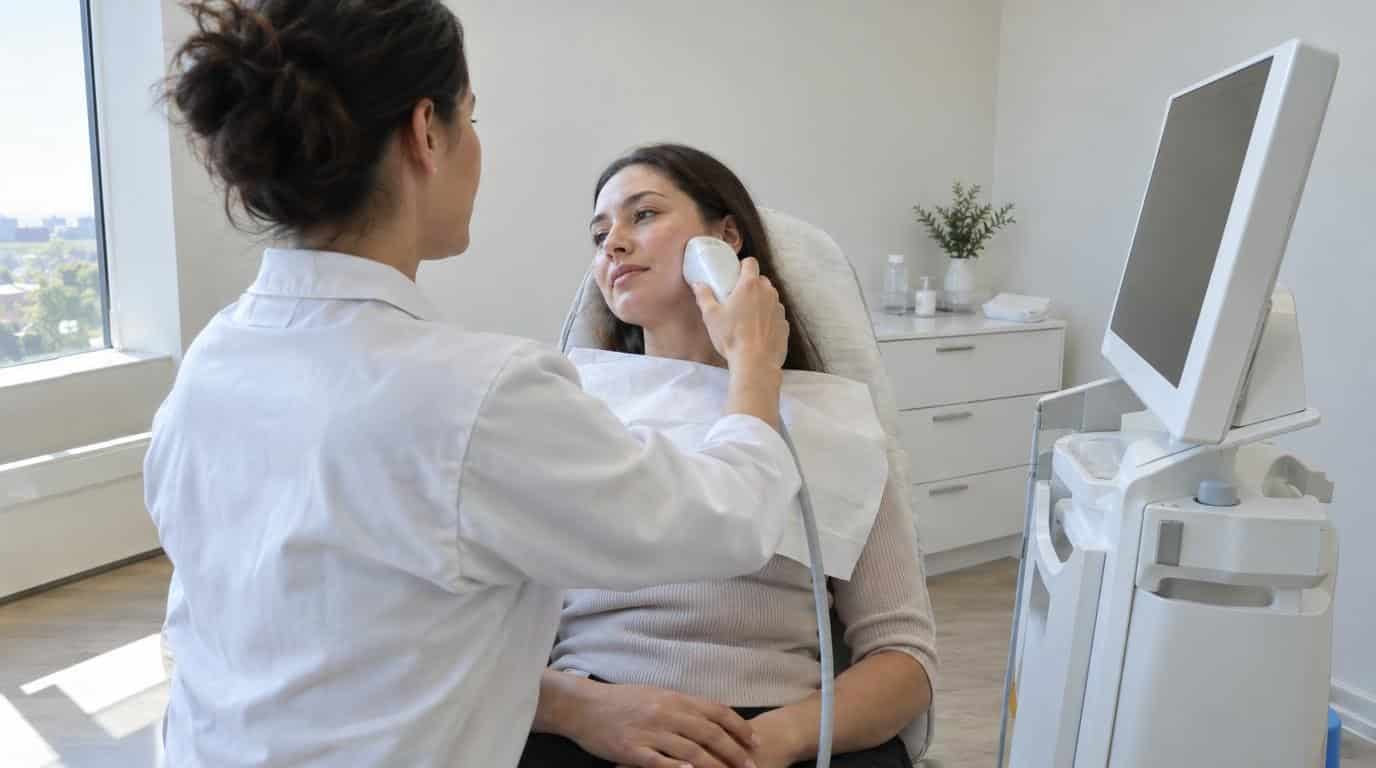
We follow these steps during an Ultherapy appointment:
- Cleanse the skin and identify the treatment area.
- Apply ultrasound gel and place the applicator on the skin.
- Use ultrasound imaging to view underlying structures, position the applicator, and deliver focused energy beneath the skin.
You may feel sensations during treatment; comfort varies by person and treatment area. At Esthetica Orange County, a typical brow-and-neck procedure takes 60 to 90 minutes, while a chest treatment may take 30 minutes.
Does Ultherapy require downtime?
Patients at Esthetica Orange County can usually return to work and normal daily activities immediately after Ultherapy. That describes expected downtime, not a promise that the skin will feel entirely normal right away. Temporary redness or tenderness may affect how comfortable someone feels returning to a particular activity.
Who is not a good candidate for Ultherapy, and what are the risks?
Ultherapy may be a poor fit when skin laxity is substantial, the main concern is not loose skin, or the desired change exceeds what nonsurgical tightening can provide. Medical history and the health of the treatment area also matter; age or a photo alone cannot establish candidacy. Side effects and uncommon complications are possible.
Evidence also has limits. The 2023 systematic review of microfocused ultrasound for facial tightening found 16 eligible studies, all involving female patients. The authors concluded that treatment can tighten mildly to moderately lax facial skin but called for more research involving male patients and more consistent objective measures.
What side effects can happen after Ultherapy?
At Esthetica Orange County, patients may have temporary flushing or pinkness for a few hours, and a few have reported temporary sensitivity or numbness to touch. The 2023 systematic review reported that treatment could be moderately painful and cause temporary redness, with or without swelling. Other adverse effects were rare (2%) in the review and included altered sensation, bruising, stinging, mandibular burns, striations, and contact dermatitis; study settings and treatment methods varied.
Tell your own qualified clinician about specific health conditions, treatment-area concerns, or prior procedures before deciding whether Ultherapy is appropriate. Seek urgent medical evaluation for a suspected burn, new facial weakness, vision changes, or severe or worsening symptoms after treatment.
Which is better, Ultherapy or laser?
Neither Ultherapy nor laser is universally better. Ultherapy uses imaging-guided, focused ultrasound to target tissue beneath the surface without intentionally treating the epidermis. Laser devices vary and may be chosen for concerns involving the skin’s surface or selected skin layers. The better option depends on whether laxity, texture, or another concern is driving the desired change.
The approaches address different goals, so a comparison should start with the outcome you want:
| Approach | Typical consideration | Important distinction |
|---|---|---|
| Ultherapy | Mild to moderate lifting or tightening | Uses imaged, focused ultrasound beneath the skin’s surface |
| Laser treatment | Skin texture and other device-dependent concerns | Depth and surface effects depend on the laser and treatment plan |
| Radiofrequency treatment | Energy-based skin tightening | Uses a different energy source and varies by device |
| Surgery | More substantial tissue repositioning or removal | Can address goals beyond nonsurgical lifting |
Is there anything better than Ultherapy?
Another option may fit a particular goal better, but there is no single best treatment for everyone. At Esthetica Orange County, chin liposuction can address a double chin caused primarily by fat, while a neck lift or facelift may better address more substantial laxity. Eyelid surgery addresses excess eyelid skin, and a brow lift is another option for pronounced brow droop. We also offer laser skin resurfacing and radiofrequency-based treatments for different concerns. The right choice depends on your anatomy, goals, and preferred recovery; our discussion of radiofrequency treatment and provider experience provides additional context.
Frequently Asked Questions
How much brow or under-chin lift has been measured after microfocused ultrasound?
Published studies have measured modest changes, not a facelift-level lift. The 2023 systematic review reported brow lifts of 0.47-1.7 mm and reductions of 26-45 mm² in the under-chin area on side-view photographs. These are study findings for microfocused ultrasound, not a prediction of your Ultherapy result.
What percentage of patients see improvement after microfocused ultrasound?
Improvement depends on who evaluates it and how it is measured. In the 2023 systematic review, pooled investigator ratings (n = 337) found improvement in skin tightening and/or wrinkle reduction in 92% of patients at day 90. Pooled patient-reported ratings (n = 81) found mild improvement in 42% at day 90 and 53% at day 360. Longer-term follow-up data were unavailable, and these group findings cannot predict your result.
Can I get Ultherapy if my BMI is over 30?
A BMI over 30 does not automatically rule out Ultherapy. The 2023 systematic review identified both a BMI over 30 and excessive skin laxity as relative, not absolute, contraindications to microfocused ultrasound because positive results declined as BMI and laxity increased. We can assess your skin and goals to help determine whether Ultherapy is appropriate.
How many Ultherapy sessions do I need?
Most of our Coronado patients require one Ultherapy session to achieve their desired result, but that observation does not predict how many initial sessions you may need in Newport Beach. We will discuss a treatment plan based on your skin and goals at your consultation.
Can I use my normal skin-care products after Ultherapy?
Yes. Cleveland Clinic says patients can resume their normal skin-care routine after Ultherapy, although temporary redness or tenderness may make some products uncomfortable.
How long can tenderness last after Ultherapy?
Tenderness can last up to one month after Ultherapy, although experiences vary, according to Cleveland Clinic. Mild temporary redness, swelling, or bruising may also occur. Seek prompt medical evaluation if pain is severe or worsening.
Does Ultherapy work for men?
Men may be candidates for Ultherapy, but the available outcome evidence is less certain for them. All eligible studies in the 2023 systematic review of microfocused ultrasound for facial tightening involved female patients; the authors called for research involving men.
How can you decide whether Ultherapy fits your goals in Newport Beach?
Start by identifying the area you want to change and whether loose skin appears to be the main concern. Ask to see comparable before-and-after examples taken after enough time for results to develop, then review the likely degree of change, recovery, and risks. An individualized assessment is more useful than relying on a photo alone.
If you are considering Ultherapy in Newport Beach, contact Esthetica Orange County to arrange a consultation with Dr. Wael Kouli. Our team can assess your concern, explain whether Ultherapy or another option better matches your goals, and discuss realistic expectations without promising a particular result.
This information is general and is not medical advice. Talk to a licensed clinician about your own situation before making a treatment decision.